50 Dollar Bill
Key facts about the fifty dollar bill, including its portrait and security features.
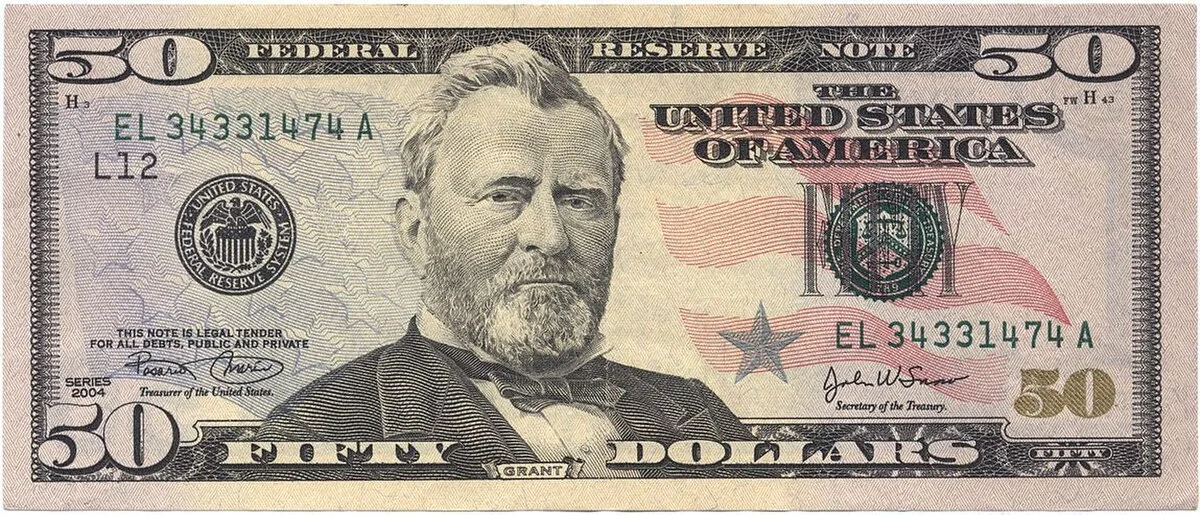
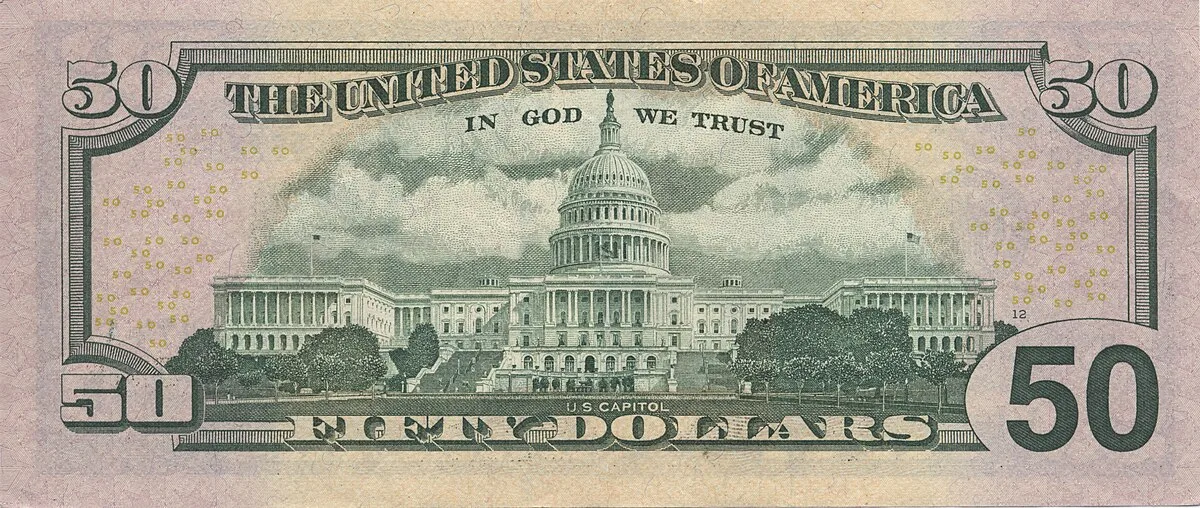
Who is on the 50 dollar bill?
Ulysses S. Grant appears on the 50 dollar bill. The reverse shows the US Capitol, tying the denomination to the seat of the legislative branch.
Grant was a Civil War general and the 18th US president. His portrait gives the fifty a distinct historical identity, while the Capitol vignette reinforces the bill's role as a higher value note used for significant purchases and transactions.
A brief history of the 50 dollar bill
The 50 dollar bill has appeared in US currency since the nineteenth century, first as large-size notes that circulated primarily in major business transactions. Those early issues were ornate and text heavy, with engraved portraits and decorative borders that reflected the engraving style of the time.
When the United States shifted to small-size banknotes in 1928, the $50 adopted the layout we recognize today. Later redesigns focused on security rather than radical visual change. The most visible update came in the early 2000s, introducing subtle color and additional anti-counterfeit technology while keeping Grant and the Capitol as the core design anchors.
Design details: Grant and the US Capitol
Grant's portrait is rendered with fine-line engraving that is intentionally difficult to copy. The Treasury and Federal Reserve seals, serial numbers, and border patterns provide additional layers of detail that help confirm authenticity.
The reverse of the 50 dollar bill features the US Capitol building, a symbol of American governance. The dome and wings create a balanced, symmetrical layout that makes the note easy to recognize at a glance, especially when compared with nearby denominations like the $20 or $100.
Security features and quick checks
Modern $50 notes include multiple anti-counterfeit features that can be verified by sight and touch. The easiest approach is to look for a few key signals rather than rely on just one. These features appear together on genuine notes.
- Watermark portrait of Grant visible when held to light.
- Security thread embedded in the paper with "USA 50" text.
- Color-shifting ink on the numeral 50 that changes when tilted.
- Microprinting around the portrait and borders.
- Raised intaglio printing that you can feel with your fingertips.
When in doubt, compare the suspect bill with a known authentic note. Consistent paper texture, sharp line work, and proper placement of the watermark and thread are the most reliable indicators.
Circulation and everyday use
The $50 bill is less common in everyday change than the $20, but it is still used frequently for larger purchases, travel, and cash withdrawals from banks. Some retailers inspect fifties more carefully because of their higher value, which makes familiarity with the security features helpful.
Because the $50 changes hands less often, many fifties stay in better condition than lower denominations. This can make them appealing to collectors who want crisp examples from modern series without a premium.
Collector value and what adds premium
Most modern 50 dollar bills trade at face value, but collectors pay more for distinctive serial numbers, star notes, and printing errors. Older series and large-size notes can carry higher premiums because survival rates are lower.
Condition is critical. Crisp, uncirculated bills command the strongest prices, while notes with heavy folds or stains typically do not. Store collectible $50 bills in archival sleeves and avoid cleaning, as cleaning can permanently reduce value.
Serial numbers, star notes, and errors
Serial number patterns can add interest and value to a 50 dollar bill. Collectors often seek low serial numbers, repeating patterns, ladder sequences, or radar numbers that read the same forward and backward. These patterns are uncommon in circulation and are popular among specialty collectors.
Star notes are replacement bills printed to substitute for damaged or misprinted notes during production. They are identified by a star symbol in the serial number. Error notes, such as misaligned prints or missing elements, can also command premiums, but authentication is important because altered notes are sometimes sold as errors.
Recognizing the $50 bill quickly
All US paper money is the same size, so quick recognition relies on color, portrait, and reverse imagery. The $50 features warmer background tones than the $20 and a more subdued palette than the latest $100, with the Capitol on the reverse serving as a clear visual cue.
If you are learning multiple denominations, compare a $50 with a $20 and $100 side by side. The portrait and building images are the fastest way to identify the note without relying on the numerals alone.
Common myths and everyday questions
Older series of the 50 dollar bill are still legal tender. Design updates and security changes do not invalidate previous notes, so a clean older $50 remains worth face value even if it lacks the newest features.
Some retailers choose not to accept large bills to manage change or reduce counterfeit risk, but that is a business policy rather than a legal restriction. Banks and credit unions accept genuine $50 notes, and most cash users find them easiest to spend on larger purchases.
Fun facts about the $50 bill
The fifty sits in a practical middle ground between everyday cash and high-value notes. It is often used for gifts or for consolidating cash because it reduces the number of bills needed to reach larger totals.
- The $50 shares the same dimensions as all modern US notes.
- Ulysses S. Grant is one of the few military leaders on current US currency.
- Modern series add subtle color to make the note easier to identify.
50 dollar bill FAQ
Who is on the 50 dollar bill?
Ulysses S. Grant appears on the obverse of the $50 bill.
What building is on the 50 dollar bill?
The reverse shows the US Capitol building in Washington, D.C.
How do I check if a 50 dollar bill is real?
Check for the watermark, security thread, color-shifting ink, and raised printing. These features should be consistent with a known authentic $50 bill.