1 Dollar Bill
The most common US dollar bill, known for its iconic Great Seal and enduring design.
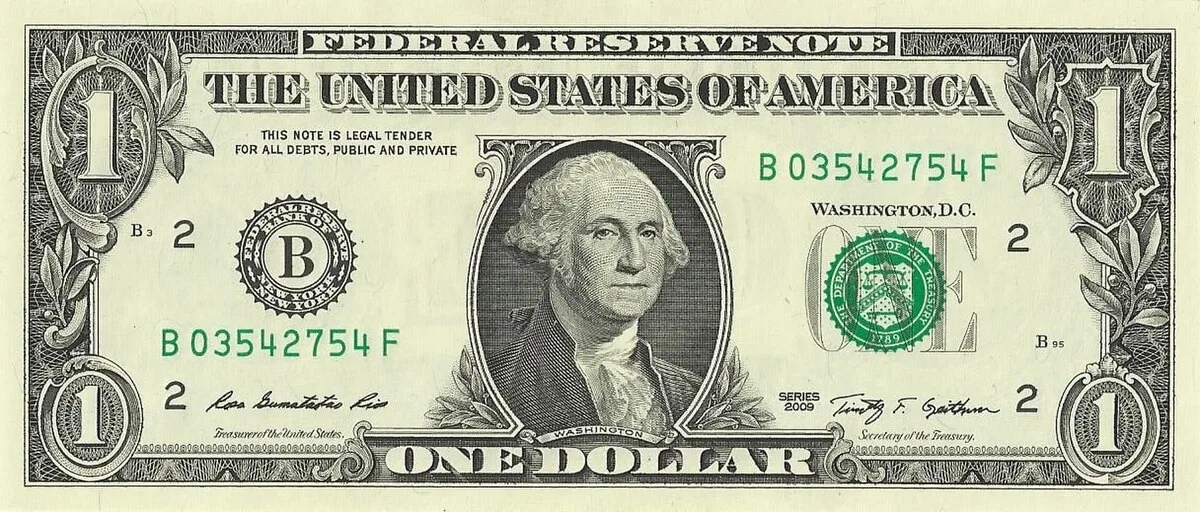
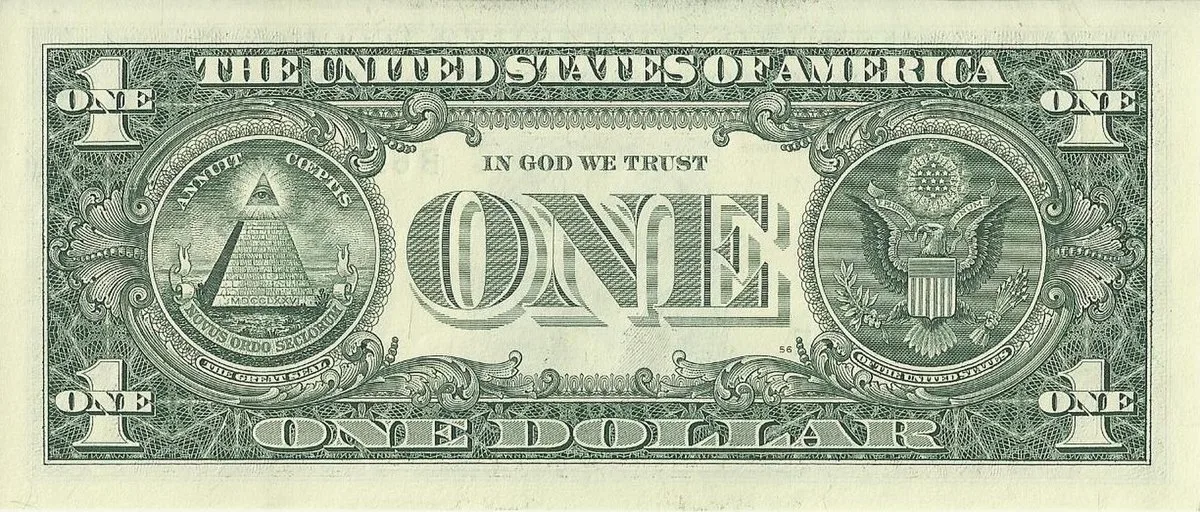
Who is on the 1 dollar bill?
George Washington appears on the 1 dollar bill. The reverse features the Great Seal of the United States.
Design and security
The $1 bill has seen relatively few security updates compared to higher denominations, relying on its simple green-and-black design and detailed engraving.
Value and collecting notes
Most 1 dollar bills are worth face value, but star notes, errors, and older series in top condition can sell for more.
A brief history of the 1 dollar bill
The 1 dollar bill has been part of daily American life since the Civil War era, when paper money expanded to meet wartime financing needs. Early $1 notes came in different formats and issuers, but the modern small-size bill arrived in the late 1920s when all US paper currency shifted to a standardized size. That change made it easier for banks and businesses to handle cash efficiently, and it is the same size we still use today. Over time, the 1 dollar bill became the most familiar piece of US currency because it circulates everywhere, from classrooms and wallets to retail cash drawers.
The current look of the 1 dollar bill is famous for its stability. The Great Seal reverse debuted in the 1930s, and the modern portrait layout appeared soon after. While higher denominations added newer colors and advanced features, the $1 kept a classic green-and-black look and detailed engraving. That continuity is part of its appeal: the 1 dollar bill is instantly recognizable, and its design has become a cultural icon in movies, art, and everyday sayings. For collectors, that long timeline creates a big range of series and varieties to explore.
Great Seal symbolism on the dollar bill
The reverse of the 1 dollar bill showcases the Great Seal of the United States, split into two halves. On the right, the bald eagle holds an olive branch and arrows, a traditional symbol of peace and readiness. The eagle also carries a banner with the motto “E Pluribus Unum,” meaning “Out of many, one.” The shield on the eagle’s chest represents unity among the states. These elements make the dollar bill more than money; it is a compact civic symbol printed for everyday use.
On the left side, the unfinished pyramid represents strength and endurance. Above it sits the Eye of Providence, a symbol of guidance. Two Latin mottos appear here: “Annuit Coeptis,” often translated as “He approves our undertakings,” and “Novus Ordo Seclorum,” meaning “A new order of the ages.” Whether you view these as historic symbols or simply design flourishes, they make the $1 bill one of the most visually layered pieces of US currency.
How to check a 1 dollar bill quickly
The 1 dollar bill does not use the advanced anti-counterfeit features found on higher denominations, so the best checks are tactile and visual. Authentic US currency is printed on a cotton-linen blend that feels crisp and slightly textured. The raised intaglio printing on the portrait and seals should feel subtly embossed, not flat like inkjet paper. Fine line engraving also holds up under close inspection, with sharp detail instead of fuzzy edges.
- Feel the paper: US notes are not standard paper and should feel firm, not slippery.
- Check the portrait and seals: raised printing adds subtle texture.
- Look for tiny red and blue security fibers embedded in the paper.
- Note what is missing: there is no watermark, security thread, or color-shifting ink on the $1.
If you need help verifying size and proportions, compare against a known bill. All modern notes share the same dimensions, and the 1 dollar bill should measure 6.14 by 2.61 inches. For a full size reference, visit the resources page.
Why the 1 dollar bill stays in heavy circulation
The 1 dollar bill is the backbone of cash transactions. It is common in tips, transit systems, convenience stores, and any purchase where exact change matters. Because it changes hands frequently, the average life of a $1 note is shorter than most other denominations. That means the Bureau of Engraving and Printing continually prints new $1 bills to keep up with everyday demand. For users, this makes the 1 dollar bill both familiar and practical, a piece of currency that is easy to recognize and easy to use.
Collector value and what makes a $1 bill special
Most 1 dollar bills trade at face value, but collectors look for specific traits that create premiums. Star notes (replacement notes marked with a star in the serial number), low serial numbers, and unusual patterns like repeating digits are popular targets. Errors such as misaligned prints or cutting mistakes can also increase value, especially when documented and professionally graded. Even common notes can become interesting if you build a themed collection focused on a year, a mint district, or a serial range.
Condition matters as much as rarity. Crisp, uncirculated notes with sharp corners and clean paper are worth more than circulated bills with folds and stains. If you find a promising $1 bill, store it in an archival sleeve and keep it flat to protect it. Collecting is less about instant profit and more about the stories these notes carry, from historical series to everyday cultural moments.
Fun facts about the 1 dollar bill
The $1 bill has the longest-running overall design among modern US banknotes. It is also full of small details that people love to point out, from the Latin mottos to the symbolic balance of arrows and olive branches. Because it is so common, the 1 dollar bill has inspired folk myths, classroom lessons, and even art projects. It is a tiny history lesson that passes through millions of hands every day.
- The Great Seal appears only on the $1 bill among modern notes.
- The portrait is based on Gilbert Stuart’s famous painting of George Washington.
- The eye above the pyramid is called the Eye of Providence.
- The $1 bill is often used in magic tricks and demonstrations because its design is so recognizable.
1 dollar bill FAQ
Is the 1 dollar bill still printed?
Yes. The $1 remains one of the most widely printed US denominations because it is used constantly in everyday transactions. New $1 bills are produced to replace worn notes and keep cash circulation steady.
Is a 1 dollar bill worth more than face value?
Typically no, but special cases like star notes, errors, or unique serial numbers can bring collector premiums. Most circulated $1 bills are worth exactly one dollar.
Who is on the 1 dollar bill?
George Washington appears on the obverse, and the reverse features the Great Seal of the United States.